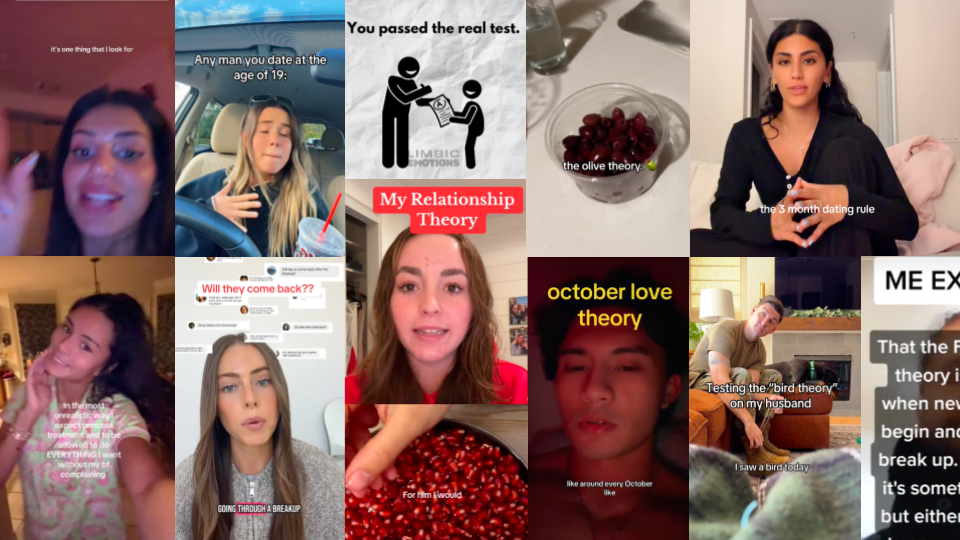
“If he wanted to, he would,” is the claim to fame for relationship-and dating-based creators on the popular social media app TikTok, who say that if a partner doesn’t buy “just because” flowers, give “princess treatment,” or commit to a relationship after exactly three months, they’re not interested.
Relationship “theories” and “tests” have now found their way to TikTok, where users are encouraged to assess their partners, “situationships,” or “talking stages” based on hypothetical scenarios to determine a relationship’s potential.
A search of “relationship theory” on the app yields many such examples: the menu theory; the olive theory; the pomegranate theory; the second love theory.
À la the pomegranate theory, if a partner is willing to perform an arduous task like peeling a pomegranate, they feel deep love and commitment. Meanwhile, according to the olive theory, compatible couples are composed of one partner who dislikes a certain type of food and one partner who loves it.
Charlotte Sudduth, a predoctoral fellow at the College of Agricultural, Consumer, and Environmental Sciences at the University of Illinois at Urbana-Champaign, says TikTok’s theories and tests originate from audience interest in learning about relationships and relationship dynamics.
“We just assume that people know how to exist in healthy relationships, when that’s really not the case for (many),” Sudduth says. “A lot of people, especially if they did not have healthy dynamics in relationships growing up, do not know how to exist in that scenario. And so there’s always been this desire within people to learn this.”
While TikTok’s theories and tests mirror pre-existing forms of relationship content, Sudduth says, like magazine articles, talk shows or “How healthy is your relationship?” online quizzes, social media content is curated and can thus create a sense of inadequacy and insecurity for many people.
Sudduth discussed the bird theory, a viral test of one partner saying to another, “I saw a bird today,” and gauging the partner’s overall interest based on their response: an enthusiastic “What bird?” or “Tell me more,” versus a less invested “Oh” or “That’s cool.”
“The bird theory is grounded in, originally, empirical research,” Sudduth says. “There is some sort of empirical basis for how your partner responds to your bids for attention. That’s a real thing. However, the test is one specific moment of a day and also it is one very particular case.”
Sudduth says, depending on a person’s business or availability, behavior can fluctuate and one’s immediate response may not determine their overall feelings. If it’s not typical for a person to point out elements like birds or trees, their partner might notice and pick up on it as well.
“That may indeed be them being understanding of you, but in turn that kind of suspiciousness might come across as unfitness for this relationship,” Sudduth says.
Sudduth says tests like the bird theory create “destiny beliefs,” or ideals that relationships are either destined to work or not.
“My concern with some of these tests is that it’s going to reinforce the idea that a relationship is either great or bad,” she says. “And if it’s bad, that means we should break up. If it’s good, that means it will always be good, and we’re good to go.”
Maewyn Trujillo, Uni freshman, agrees that the bird theory might perpetuate ideas of a “good relationship” versus a “bad relationship.”
“It shouldn’t be like, ‘If this happens, maybe you should break up or it isn’t gonna work,’ because every relationship is different,” Trujillo says. “Every person’s different. It’s not gonna look the same.”
Instead, Sudduth encourages approaching relationships with a “growth belief” or mindset.
“Having a growth mindset in a relationship typically protects relationship stability over time,” Sudduth says. “You have this sense of ‘If something goes wrong in our relationship, we can work together to fix that and move forward.’”
A particular relationship trend on TikTok is the “boo basket,” a collection of one’s favorite items arranged in a basket for an occasion like Halloween, National Girlfriend’s Day or Valentine’s Day.
On TikTok, relationship-based content creators post about their partners making boo baskets for them of expensive items and gifts. Sudduth says, in the case of boo baskets, many content creators may encourage their partners to purchase one beforehand, creating a false sense on social media.
“A lot of content creators depict their content as very natural and occurring in everyday life, but for a lot of people those are kind of contrived situations,” Sudduth says. “In real life, people then assume, ‘Well, my partner should know how to love me. My partner should know how to care for me.’”
In young relationships, Sudduth says people are not born knowing to make boo baskets or buy flowers on random occasions. “Social media can take that learning curve and make it seem like something people just innately know,” she says.
On social media, content creators tend to focus on the “highlight reel” of relationships, staying away from discussing conflicts and issues, Sudduth says.
Some viewers may then compare their relationships to what they see on TikTok, thus perpetuating comparison and a sense of inadequacy. About 70% of Gen Z social media users say their emotions are affected by what they see online, according to a Pew Research poll.
Some users have also pointed out the possible anxiety caused by #relationshiptok: “Your (boyfriend) isn’t cheating,” says a video with almost 240,000 views. “The three-month rule isn’t a thing. True teenage love is real. Stop letting social media give you a reason to sabotage.”
“You know your relationship best,” Sudduth says. “You’ve seen what happens in your day-to-day relationship. … If you’re seeing a content creator who’s posting that their partner loves them so much (in a ten-second TikTok), that’s all they post about, that’s all you’re gonna see and that’s what you’re gonna think is normal.”
Trujillo says this comparison can create a space where people aren’t able to experience their relationships fully.
“Having these tests and experiments kind of might ruin it a little bit,” Trujillo says. “It takes out the self-discovery of it all. And it puts pressure on it … It just ruins it for you when you’re not able to figure out things for yourself.”
Instead, Sudduth encourages people to communicate with their partners and share what they need to feel loved.
“If you see this kind of content on social media, you feel this expectation creeping in,” Sudduth says. “You’ll say, ‘Oh, I’m really hoping my partner does this for this day,’ or just in general, ‘I hope he knows to open doors for me. I hope he knows that he needs to be buying me flowers this often.’
I think expressing those desires to your partner in a way that says, ‘Hey, I saw this on social media. How does that fit into our relationship? Would that work for our relationship? Is that actually realistic for our relationship given our budget and the amount of time we can spend together?’”